
Dementia

Our team investigates fundamental mechanisms and translates findings from bench to bedside, combining preclinical models with clinical insight.

Researcher at ICRC with focus on translational medicine. Combines preclinical insights with clinical practice across cardiology, neurology, and oncology programs.

Currently leads / contributes to interdisciplinary projects bridging molecular biology, imaging, and patient care at St. Anne's University Hospital Brno.

Research Group

Team size
Team size: 19 Researchers
Place
Place: Building A1, 3rd Floor
Collaborates with
Collaborates with MUNI Clinic

Head of Research Group

prof. MUDr. Jakub Hort, Ph.D.

Members

MUDr. Martina Mračková, Ph.D.

MUDr. Martina Mračková, Ph.D.

Junior Researcher

MUDr. Julie Nováková Martínková

Junior Researcher

prof. MUDr. Jan Laczó, Ph.D.

Senior Researcher

MUDr. Martin Vyhnálek

Senior Researcher

MUDr. Pavel Filip, Ph.D.

Postdoctoral Researcher

MUDr. Rastislav Šumec, Ph.D.

Postdoctoral Researcher

Mgr. Monika Kunzová, Ph.D.

Mgr. Monika Kunzová, Ph.D.

Postdoctoral Researcher

MUDr. Roman Bednár, Ph.D.

MUDr. Roman Bednár, Ph.D.

Postdoctoral Researcher

Mgr. Patrik Šimko, Ph.D.

Mgr. Patrik Šimko, Ph.D.

Postdoctoral Researcher

Mgr. Veronika Matušková, Ph.D.

Mgr. Veronika Matušková, Ph.D.

Research psychologist

Mgr. Tomáš Kubík

Mgr. Tomáš Kubík

Research psychologist

Mgr. Jan Ondřej

Research psychologist

Mgr. Zuzana Konečná

Research Nurse

Bc. Monika Kseňáková

Bc. Monika Kseňáková

Research Nurse

MUDr. Kateřina Sheardová, Ph.D.

MUDr. Kateřina Sheardová, Ph.D.

Principal Investigator, Senior Research Team Leader

Francesco Angelucci

Francesco Angelucci

Principal Investigator

Ing. Monika Kurečková

Ing. Monika Kurečková

Data Specialist, Research Coordinator

Mgr. Barbora Frantelová

Mgr. Barbora Frantelová

Research Coordinator

Team Assistant

Main Objectives

  1. Evaluation of neuropsychological and spatial navigation tests as an early markers of neurodegeneration.
  2. Defining structural, metabolic and functional biomarkers on MRI and PET in humans.
  3. Exploring epidemiological risk factors in primary and secondary prevention of dementia.

Research focus

The current research of Dementia Research Group is based on the Czech Brain Aging Study (CBAS) – a unique national, multicentric, longitudinal prospective cohort study. The aim of CBAS is to study the early functional, metabolic, structural and genetic biomarkers of Alzheimer´s Disease and other dementias in blood, CSF and magnetic resonance imaging with focus on synucleinopathies, tauopathies and TDP-43-pathies. These studies are complemented by animal studies with emphasis on translational aspect of the used methodology. CBAS also explores the effect of lifestyle factors on the brain maintenance using questionnairs and nonpharmacological interventions. CBAS team consists of two core synchronized sites – Cognitive Centers at ICRC St. Anne´s University Hospital Brno and at Motol University Hospital, Prague. 

Partners and collaborating institutions: University of South Florida, Tampa, FL, USA; Harvard University, Cambridge, MA, USA; Nanjing Drum Tower Hospital, Nanjing, China; EADC – European Alzheimer Disease Consortium; eDLB – European DLB consortium; Alzheon; University of Gothenburg, prof. Kaj Blennow

Offered services and expertise: Translational research, data analysis, longitudinal study, biomarkers of neurodegenerative disorders, neuropsychology, neuroimaging, cerebrospinal fluid analysis, blood biomarkers, clinical trials.

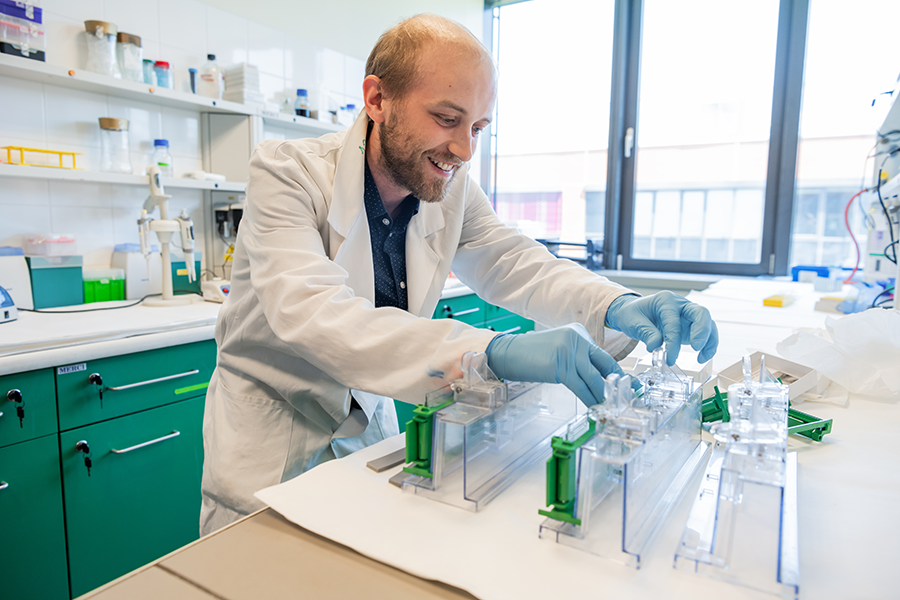
Technological equipment

  • 3T MRI– multimodal brain imaging, diffusion tensor imaging, functional magnetic resonance imaging (fMRI).

Selected Results

  • Database REDCap of Czech Brain Ageing Study with data describing the changes in the structure and metabolism of the brainover time in healthy elderly patients, in patients with MCI, and AD.
  • Bank of biological samples for genetic and biochemical analysis in the future for individuals who became ill with AD.
  • Cognitive data repository using specific neuropsychology protocols and tools for testing hippocampus-related memory impairment as an early specific sign of AD.
  • MRI database for the longitudinal study of brain atrophy in patients with cognitive impairment.
  • SHEARDOVA, K., VYHNÁLEK, M., NEDELSKÁ, Z., LACZÓ, J., ANDEL, R., MARCINIAK, R., CERMAN, J., LERCH, O., HORT, J. Czech Brain Aging Study (CBAS): prospective multicentre cohort study on risk and protective factors for dementia in the Czech Republic. 2019, BMJ Open, 9(12)
  • COUGHLAN, G., LACZÓ, J., HORT, J., MINIHANE, A.M., HORNERGER, M. Spatial navigation deficits – overlooked cognitive marker for preclinical Alzheimer disease?. Nat Rev Neurol. 2018;14(8):496-506.
  • NEDĚLSKÁ, Z., ANDEL, R., LACZÓ, J., VLČEK, K., HOŘÍNEK, D., LISÝ, J., SHEARDOVÁ, K., BUREŠ, J., HORT, J. Spatial navigation impairment is proportional to right hippocampal volume. Proceedings of the National Academy of Sciences of the United States of America. 2012, 109(7), 2590-2594.
  • LACZÓ, J., ANDEL, R., VYHNÁLEK, M., MATOŠKA, V., KAPLAN, V., NEDELSKÁ, Z., LERCH, O., GAŽOVÁ, I., MOFFAT, S., HORT, J. The effect of TOMM40 on spatial navigation in amnestic mild cognitive impairment. Neurobiology of Aging. 2015, 36(6), 2024-2033.
  • CHMÁTALOVÁ, Z., VYHNÁLEK, M., LACZÓ, J., HORT, J., SKOUMALOVÁ, A. Analysis of lipophilic fluorescent products in blood of Alzheimer´s disease patients. Journal of Cellular and Molecular Medicine. 2016, 20(7), 1367-1372.